The problem of creating a database of porn watchers that can be used for blackmail affects everyone, but of course the Rainbow Reich has to make everything all about themselves. I'm sure the VPN providers are thrilled.
This law has nothing to do with protecting children, it's a tool to justify government censorship (banning uncooperative websites) and espionage (tying the use of these websites to personally identifiable information). And since there are countries where homosexuality is punishable by death, there is a credible argument that forcing a homosexual-focused website to collect personally identifiable information about its users is going to get someone killed.
The downside is giving government regulators their foot in the door to deciding what sites end-users can access
This already exists. Except it happens slightly more subtly in the form of "hate speech" or "incitement" rules that only happen to be enforced against those who are opposed to the regime. Maybe the government didn't explicitly order big tech to "take out Alex Jones" but was the effect of what happened to him any different than if it did?
At this point I'm getting pretty tired of losing. If adopting the enemy's principle of "anything that hurts my enemy is good, anything that helps him is bad" means winning then so be it. Survive first, regain our humanity afterwards.
Degenerates like porn, and money made from porn support my enemies. Making it harder to access reinforces the culture I want. Therefore this is only a good thing.
Pornographic websites in Britain will soon be legally required to verify user ages as government ministers revive the so-called “porn block” ban.
Ministers said on Tuesday (8 February) that the Online Safety Bill, expected to reach the House of Commons in March, will be tweaked to shield children from explicit materials.
To keep under-18s away from porn sites, users will have to provide personal data such as their credit card or passport details to prove they are over 18.
The measures will apply to commercial porn sites, as well as subscriber-based content platforms such as OnlyFans. How such checks will be enforced are not yet clear, and it will be up to the companies to decide how to comply with the new regulations.
The Department for Digitial, Culture, Media and Support said other potential age verification checks could include reviewing a user’s age against mobile phone provider data. The Age Verification Providers Association has even suggested analysing a person’s selfie.
If a provider fails to comply, media watchdog Ofcom would be given the power to impose fines of up to 10 per cent of the company’s annual turnover and even block them from operating in Britain via blacklists issued to the country’s ISPs.
“Parents deserve peace of mind that their children are protected online from seeing things no child should see,” said digital minister Chris Philp in a statement.
“We are now strengthening the online safety bill so it applies to all porn sites to ensure we achieve our aim of making the internet a safer place for children.”
The policy has not clarified what guarantees – if any – the law will protect people’s privacy and data.
After all, a database of pornographic users would be a treasure trove for hackers or blackmailers, especially for LGBT+ users, online privacy group Open Rights Group has previously warned. The new proposals do not protect people from scammers tracking and profiling porn viewing, they said.
The Conservative Party first pitched the idea of age checks for pornography in 2015 during the general election campaign. They were due to come into effect in 2019, but eventually dropped after delays and technical hurdles.
Government ‘porn-block’ plan is a ‘quick win’ without tackling the real problems, say activists
Though some sex work activists and experts have welcomed measures to “ensure adult consensual engagement with commercial sex websites”, others argue that improving sex and relationships education would be a more meaningful way of reducing harms faced by children.
Jason Domino, porn actor and sex worker rights activist, fears that the “true nature of the bill is about not only censorship, but about the government wanting to have leverage against organisations”.
He told PinkNews: “The reason why it seems that way is because it’s not paired with any real dedication towards improving sexual relationships education. So there isn’t any movement to make real changes in pleasure-focused inclusivity.”
Reducing the harms children face online, Domino said, could be “more effectively achieved by contextualising for children the fact that there is sex, there is reality, there is fantasy. The understanding of consent is also really important within this conversation.”
He warned that simply barring young people from accessing porn without taking steps to educate them, too, may push some on to the Dark Web.
“And as soon as you push people into that sort of space,” Domino added, “you open up a whole raft of opportunities for them to discover things that the government do not want them to discover.”
The porn sector not being consulted in policy-making, Domino added, signals that the government does not care about sex worker’s concerns around access, privacy and safety. It also suggests lawmakers are ignorant, or indifferent, to how such restrictions would impact queer young people and sex workers alike.
“There are very few steps into normalising LGBT+ sexuality, relationships and understanding about the body,” he continued. “There is nothing about increasing the protections there.
“The queer community has a heritage of things being illegal, and so often sexual content has been more ‘get away with what you can’ because there haven’t been the spaces for people to do it in a way that is supported and nurtured, for people who don’t know what they like can feel safe. There’s none of that being suggested.”
Ross Anderson, professor of security engineering at the University of Cambridge, pointed out to Sky News that the “porn block” could out LGBT+ teens to their parents, and that many young people are savvy enough to circumvent basic age verification barriers.
Teela Sanders is part of Beyond the Gaze, a group that researches and promotes better working practices, regulation and safety for online-based sex work in Britain.
“The research conducted for Beyond the Gaze very much centres how online technologies can act to keep sex workers and content creators safe, with the ability to introduce a range of precaution and safety measures,” Sanders, also a professor of criminology at the University of Leicester, told PinkNews.
“However, there has been little attention regarding who can view content and this is a welcome move to ensure adult consensual engagement with commercial sex websites.
“There needs to be further checks and balances to ensure that content for adults and children are separated and age verification processes could be a quick win and put the responsibility on platforms and not parents.”
The “porn block” is part of the Online Safety Bill. Touted as a way to restrain Big Tech, it has already sparked concern among free speech campaigners, with fears raised about how it could be used to silence people on social media.
Definitely a wolf in sheeps clothing situation. While I support banning pornography, the database situation is unnerving. It would be better to just abolish the industry itself rather than restricting it at the ISP level.


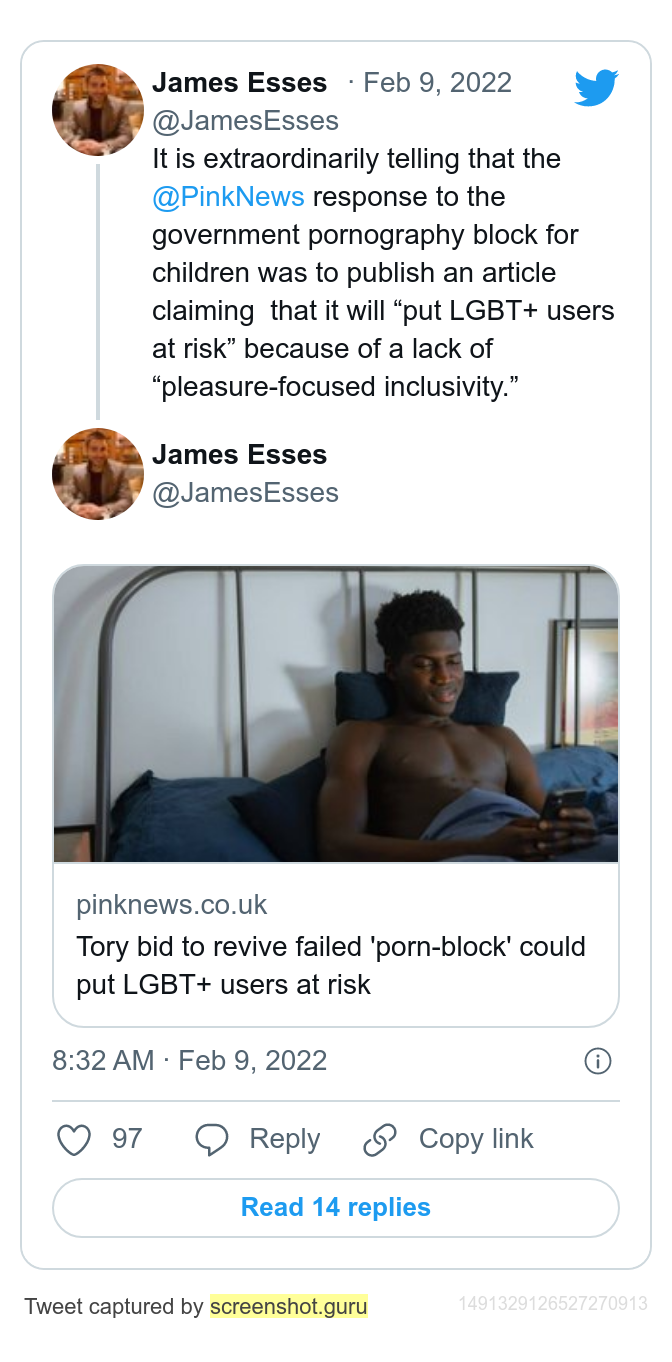

The problem of creating a database of porn watchers that can be used for blackmail affects everyone, but of course the Rainbow Reich has to make everything all about themselves. I'm sure the VPN providers are thrilled.
So homo kids can't also look at porn just like their normal peers? Ok, that's fine.
won't someone think of the faggots
like we're not forced to every day already
Why are pedophiles being allowed to speak for gay people...still?
Gays 👏
Reproduce 👏
By 👏
Sexual 👏
Abuse 👏
This law has nothing to do with protecting children, it's a tool to justify government censorship (banning uncooperative websites) and espionage (tying the use of these websites to personally identifiable information). And since there are countries where homosexuality is punishable by death, there is a credible argument that forcing a homosexual-focused website to collect personally identifiable information about its users is going to get someone killed.
based
So what you are saying is that there is no downside?
This already exists. Except it happens slightly more subtly in the form of "hate speech" or "incitement" rules that only happen to be enforced against those who are opposed to the regime. Maybe the government didn't explicitly order big tech to "take out Alex Jones" but was the effect of what happened to him any different than if it did?
At this point I'm getting pretty tired of losing. If adopting the enemy's principle of "anything that hurts my enemy is good, anything that helps him is bad" means winning then so be it. Survive first, regain our humanity afterwards.
Degenerates like porn, and money made from porn support my enemies. Making it harder to access reinforces the culture I want. Therefore this is only a good thing.
The difference is, the current form of it, requires them to have the burden of proof.
They have to Investigstet, collect and prove beyond a doubt. It can be challenged in court and people can slip the net.
This new bill means we incriminate ourselves. Worse still we incriminate our selves for potential FutureCrime of crimes that are not yet law.
Your name is in a register that they can use to blackmail you over and if the law changes go "AHA!"
There are no downsides and here's why that's a problem....
Who cares? If that is a problem use a VPN.
https://www.pinknews.co.uk/2022/02/08/tory-porn-block-ban-lgbt/
Definitely a wolf in sheeps clothing situation. While I support banning pornography, the database situation is unnerving. It would be better to just abolish the industry itself rather than restricting it at the ISP level.
Its the parents job to control what their kids see, not the government