Traditional Japanese culture is collectivist. Naturally when they come across something that opposes their traditions and culture like communism, they label it as individualistic. I've seen right wing Japanese people even today who label communism and socialism as individualistic
probably means liberal values of equality, natural rights etc
when taking to extreme, you get socialism and communism where everyone is supposed to be absolute equal and everyone gets everything - but to do so in practice it leads to totalitarianism to enforce the ideology
Think of it in terms of how socialism and communism, though collectivist, overwhelmingly emphasize the state as the most important entity for individuals to organize their lives around, to the exclusion of family, church, or any other traditional institution.
Juxtapose the title(s) of Houllebecq's novel on this topic: The Elementary Particles (or Atomized for some translations/printings). It's 'about individuals' insofar as it breaks down all other 'bonds' between people (hence the chemistry metaphor) to create the ideal horde of atomized goyslop gobblers.
The crux of the distinction for me is that on the one hand, functional religions are informed by all the centuries of organic wisdom and tradition built up by a people, whereas socialism is a set of abstract, pie-in-the-sky utopian ideals that conceptualizes all humans as identical in their fundamental nature and malleable in their behavior.
To be fair: the people who came up with those ideals understandably did not foresee them being applied to rationalize things like urinating on each other at pride parades to own the Christians.
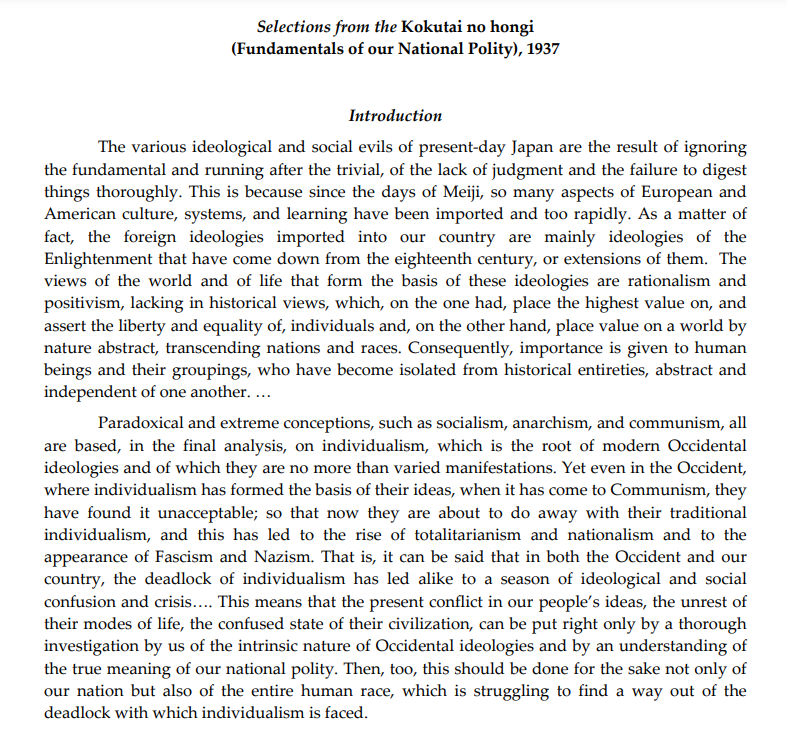
"where individualism has formed the basis of their ideas, when it has come to Communism, they have found it unacceptable, so that now they are about to do away with their traditional individualism."
You see it here in the west now: appeals to individualism, particularly the darker sides of it (degeneracy and vice, victim Olympics, selfish want for gibs) were the honey that brought the flies to the collectivist table. Pretty much all communist revolutions began by appealing to the darker nature of individualism to begin their revolutions. After which, they do away with individualism by killing off the revolutionaries themselves.
It's an interesting point of view from an outsider born in a society where collectivism was the traditional and fundamental mean.
what makes you think they would be mad that it wasn't their idea first? communism is about forcing equality. Traditional Japanese were never about that, they always had clear social hierarchies, and caste systems. They'd hate an ideology (Communism) that would try to overthrow that caste system. Imperial Japan banned communism and threw communists in to prisons, and it was actually America that got rid of that law that banned communists so who is actually more pro communist?


... What.
Socialism and communism are literally the opposite of individualism.
I'd need to read the original Japanese (which I can't do at that level) or something, because it sounds retarded.
Traditional Japanese culture is collectivist. Naturally when they come across something that opposes their traditions and culture like communism, they label it as individualistic. I've seen right wing Japanese people even today who label communism and socialism as individualistic
I think what they really mean are 'humanistic' and 'materialistic', from a western understanding of the terms. .
Also because socialism originated as an extrapolation of liberal reasoning.
probably means liberal values of equality, natural rights etc when taking to extreme, you get socialism and communism where everyone is supposed to be absolute equal and everyone gets everything - but to do so in practice it leads to totalitarianism to enforce the ideology
Think of it in terms of how socialism and communism, though collectivist, overwhelmingly emphasize the state as the most important entity for individuals to organize their lives around, to the exclusion of family, church, or any other traditional institution.
Juxtapose the title(s) of Houllebecq's novel on this topic: The Elementary Particles (or Atomized for some translations/printings). It's 'about individuals' insofar as it breaks down all other 'bonds' between people (hence the chemistry metaphor) to create the ideal horde of atomized goyslop gobblers.
Yeah. They emphasize the state. Aka the collective
I think that's what it is. Communism destroys actual communities and atomizes people. Hence you can call communism as individualistic.
Then what about Socialism, which is basically voluntarily pooling resources towards some common goal?
sooo like a religion? you could call religion as "socialist" if you define socialism as "voluntarily pooling resources towards some common goal"
The crux of the distinction for me is that on the one hand, functional religions are informed by all the centuries of organic wisdom and tradition built up by a people, whereas socialism is a set of abstract, pie-in-the-sky utopian ideals that conceptualizes all humans as identical in their fundamental nature and malleable in their behavior.
To be fair: the people who came up with those ideals understandably did not foresee them being applied to rationalize things like urinating on each other at pride parades to own the Christians.
I don't see how you can use socialism and voluntary together in the same sentence.
It makes no sense. we need to copy and paste the original into chatgpt or something
"where individualism has formed the basis of their ideas, when it has come to Communism, they have found it unacceptable, so that now they are about to do away with their traditional individualism."
You see it here in the west now: appeals to individualism, particularly the darker sides of it (degeneracy and vice, victim Olympics, selfish want for gibs) were the honey that brought the flies to the collectivist table. Pretty much all communist revolutions began by appealing to the darker nature of individualism to begin their revolutions. After which, they do away with individualism by killing off the revolutionaries themselves.
It's an interesting point of view from an outsider born in a society where collectivism was the traditional and fundamental mean.
But fundamentally, communism/socialism/fascism are collectivist ideas.
Ignoring the likely propagandistic leanings of the text, they might just have been mad that it wasn't their idea first.
what makes you think they would be mad that it wasn't their idea first? communism is about forcing equality. Traditional Japanese were never about that, they always had clear social hierarchies, and caste systems. They'd hate an ideology (Communism) that would try to overthrow that caste system. Imperial Japan banned communism and threw communists in to prisons, and it was actually America that got rid of that law that banned communists so who is actually more pro communist?