I'd say that the claims that it ended German capabilities and demoralized the population are more provocative than correctly calling it a massacre. Even granted that massacring civilians is justified if it furthers a war end, there are at best serious questions regarding how much the Dresden raid did to do that.
At least the atomic bombs ended the war. This is thought to have done nothing at all.
That's where you're wrong though. Not trying to be a Stormfag, but murdering civilians had been a major aim of Bomber Command for most of the war. They called it 'dehousing' German workers. If they happened to live there, then that's too bad for them.
The Allies accepted that civilian casualties would be high and deemed it necessary.
Of course they didn't give a damn. Unfortunately, that's not how politics works. You don't get to the top of the greasy pole by caring about the civilians of your belligerent.
I find it funny you'd call this a massacre but given your history of Lincoln apologist would call the destruction of Georgia a part of war.
Very few people were actually murdered during the destruction of Georgia. So that definitely was not a massacre.
So somewhere between 3,000 and 25,000 it becomes a massacre? Sherman also didn't have bombers and his opponent hadn't declared total war on him first....
I don't know about the 3000, but I'll accept it for the sake of the argument. I'd say that if Sherman rounded up 3000 and executed them in one or a few days, sure, that's a massacre. Even 300. But while scattered killings are bad, I don't think they qualify as a massacre.
I shouldn't have brought it up it wasn't germane.
No, it's a perfectly fair question. Only people who proudly wear hypocrisy on their sleeves will whine about 'whataboutism' when called out about it - they don't even know what it means.
Destroying the enemies capability to continue warfare is the highest ideal. Do I think the Allies first priority was the reduction of civilian casualties, no obviously not. But their main purpose wasn't the destruction of human lives.
That is a very broad formulation, which may include almost any action. Perhaps massacring an entire city would destroy the enemy's morale (as you said) and thus reduce the capability to continue warfare. Regardless, I don't know enough to the specifics to either confirm or contradict. Only that the raid on Dresden, even when viewed with the most rose-tinted glasses, is grossly disproportionate to what they were supposed to get from it.


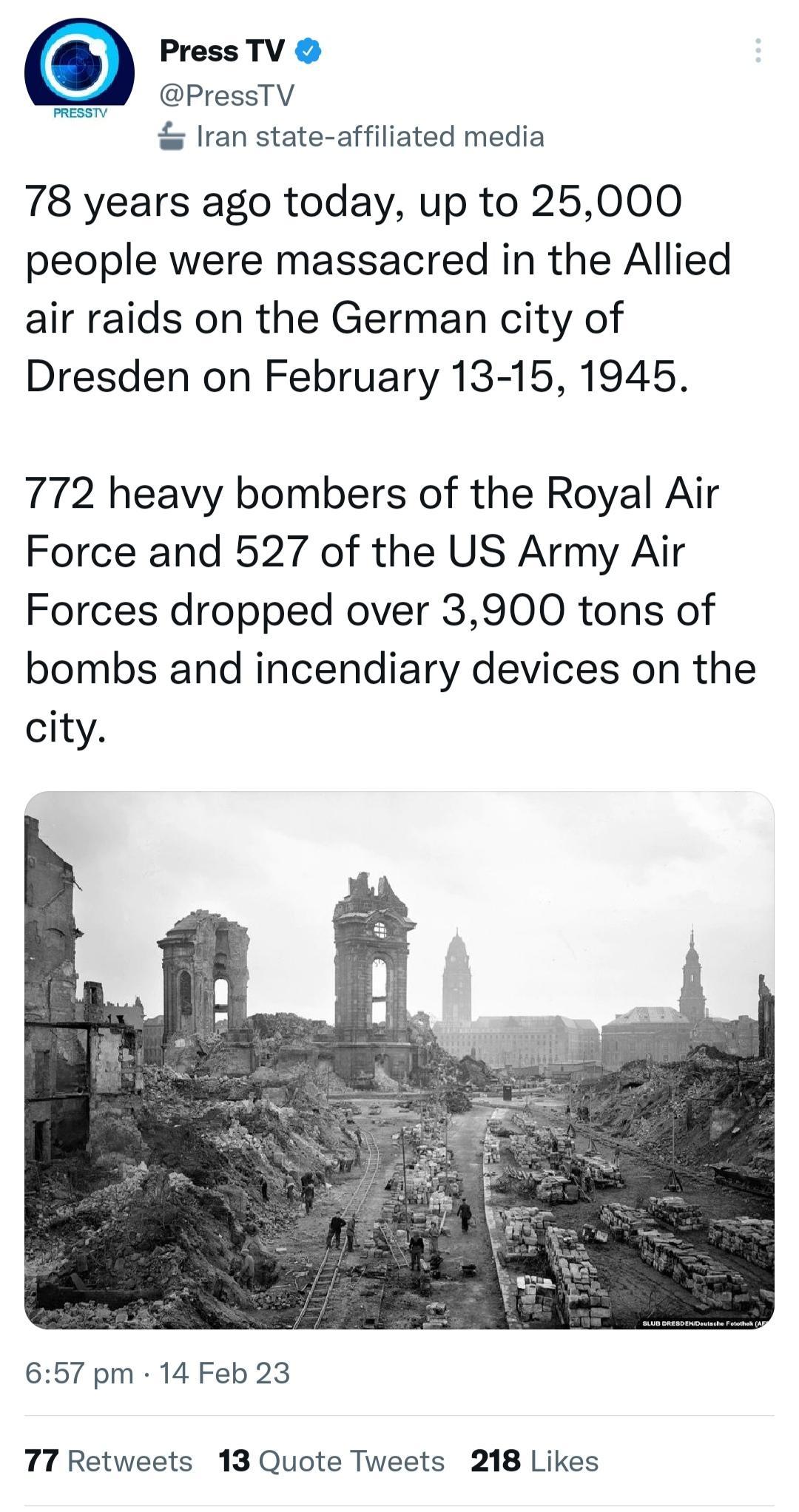

I'd say that the claims that it ended German capabilities and demoralized the population are more provocative than correctly calling it a massacre. Even granted that massacring civilians is justified if it furthers a war end, there are at best serious questions regarding how much the Dresden raid did to do that.
At least the atomic bombs ended the war. This is thought to have done nothing at all.
That's where you're wrong though. Not trying to be a Stormfag, but murdering civilians had been a major aim of Bomber Command for most of the war. They called it 'dehousing' German workers. If they happened to live there, then that's too bad for them.
Of course they didn't give a damn. Unfortunately, that's not how politics works. You don't get to the top of the greasy pole by caring about the civilians of your belligerent.
Very few people were actually murdered during the destruction of Georgia. So that definitely was not a massacre.
I don't know about the 3000, but I'll accept it for the sake of the argument. I'd say that if Sherman rounded up 3000 and executed them in one or a few days, sure, that's a massacre. Even 300. But while scattered killings are bad, I don't think they qualify as a massacre.
No, it's a perfectly fair question. Only people who proudly wear hypocrisy on their sleeves will whine about 'whataboutism' when called out about it - they don't even know what it means.
That is a very broad formulation, which may include almost any action. Perhaps massacring an entire city would destroy the enemy's morale (as you said) and thus reduce the capability to continue warfare. Regardless, I don't know enough to the specifics to either confirm or contradict. Only that the raid on Dresden, even when viewed with the most rose-tinted glasses, is grossly disproportionate to what they were supposed to get from it.